SF Ballet's Program Two, Reviewed: Culture/Entertainment: SFAppeal

May 23, 2012 More Feeds

Culture/Entertainment

SF Ballet's Program Two, Reviewed

user-pic
  • 2 Comments
  • +0 Votes
  • Share
  • Email


Tuesday night, San Francisco Ballet carved through time and space in Program 2. This is the first mixed bill of the season, and in an ode to contemporary ballet, the company looked sleek and versatile in the late Jerome Robbins' Opus 19/The Dreamer while molding themselves into taught and rhythmic shapes in Paul Taylor's Company B.

dance1
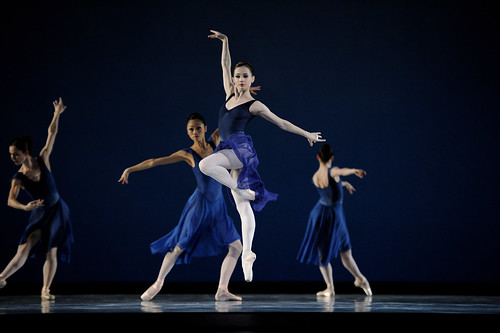
Maria Kochetkova in Robbins' Opus 19/The Dreamer. © Erik Tomasson

Opus 19/The Dreamer soared to my attention as Davit Karapetyan (a late replacement for Taras Domitro in the role originated by Mikhail Baryshnikov) lunged forward at center stage and widened his arms with a quiet forcefulness as if inviting the audience into his fantasy.

This ballet is plotless, but there's a dreamlike suspense throughout: supple white clouds against a pale blue background and various sapphire-hued costumes, including skirts that graze the unnamed space between the women's knees and calves. Maria Kochetkova, a tiny angel of a dancer, entered with giant windmilling arms and scissor-kicking skips, and as the piece progressed, she continued to pull Karapetyan on a string through his deep and whimsical trance as Franklin D'Antonio's violin finely soared above the orchestra.

The corps of men and women moved about with a floating ease; Robbins' choreography, which includes some traditional ballet with modernish movement including flexed feet and hands, and upper body contractions, looked so natural on the dancers, like this work was made for them. Even though this ballet debuted in the late 70s, the work itself doesn't look dated. In fact, it felt fresher than Christopher Wheeldon's premiere of Ghosts.


dance2
San Francisco Ballet in Wheeldon's Ghosts. © Erik Tomasson

Over the past 10 years, Wheeldon has pretty much been hailed as the best thing to happen to bourrées since Balanchine, but Ghosts isn't quite up to snuff. Wheeldon casted a cadre of incredibly strong and articulate dancers, but most of them dance in unison (and there's lots of unison and canon, too, which after awhile gets really, really repetitive), and the duets and trios, fleeting as they are, do nothing to advance the relationships of this "mass gathering of souls."

In the past, Wheeldon has excelled at partnering work, creating new shapes through the unique ways he connects each position. But in Ghosts, it all seemed muddled and hindered even more so by the color scheme of olives, browns, and creams, the warm lighting that blended together, and the creaking structure hung high above the stage.

The title refers to C.F. Kip Winger's score; Winger was a bassist with Alice Cooper's band back during the 80s. Knowing this, I expected a blasting score or at least something above average, but instead it was a screeching bit of orchestral blah. The orchestra put their all into it, but even Super Glue couldn't save this one (and I'm not even wasting any puns on references to graves, an early death, or a much needed exorcism. That says a lot right there).

dance3
Sarah Van Patten in Taylor's Company B. © Erik Tomasson

Luckily, Paul Taylor's Company B brought everything back into focus. Created in 1991, Company B reflects on the mood during World War II, contrasting the Andrews Sisters' uplifting songs with the difficulties of going to war.

My date commented that the ballet could also be an allusion to the 80s and AIDS, and it's true. The theme here could be universal and apply to many times of joy and despair.


What: San Francisco Ballet's Program 2

Where: War Memorial Opera House, 301 Van Ness Ave, San Francisco

When: Now through Saturday, Feb. 20

Tickets: Online, via 415.865.2000, or at the Ballet Box Office at 301 Van Ness Ave.

Company B is an ensemble work for 13 dancers, and everyone looked well rehearsed in the Paul Taylor style, which is a little jazzy and stresses a lot of whole body movement. Taylor, though, isn't one for 180 degree splits. Moderation and refinement is key here.

Pascal Molat's infectious "Tico, Tico" brought chuckles from the audience, and his ability to control every piece of his body while looking so loose and free is utterly astounding. Sarah Van Patten continues to pull tricks out of her bottomless hat, this time with an organic and somber take on the "I Can Dream, Can't I?" solo. Quinn Wharton (who also has an amazing photographic eye) and Brett Bauer, two statuesque men in the corps, were also in fine form (as were they earlier in the evening).

As the company seems in need of some taller, strong male dancers for soloist and lead roles, perhaps, Mr. Tomasson, take note: You have some excellent in-house talent--utilize it well!

Overall, this was a strong program, and I look forward to seeing more of SF Ballet this season.